Quick Login (Optional)
Login is completely optional. Your cart will be saved automatically for this browser session.
Continue as Guest
No account needed! Your cart is automatically saved for this browser session.
Create new account
Create your account to be part of the BitcoinButik world, discover our new collections and receive news from the Maison.

Bitcoin vs. Gold: What’s the Difference and Which Is Better?
What if the oldest store of value in history had to compete with the newest? Gold has been used to preserve wealth for thousands of years, while Bitcoin has emerged as a scarce digital asset with a radically different approach to ownership and value. This raises an important question for modern investors: Bitcoin vs gold—which is the better investment?
Gold has long been associated with stability, trust, and wealth preservation. Bitcoin, often referred to as “digital gold,” offers scarcity, global accessibility, and the potential for significant growth—but with considerably higher volatility and risk.
So, which one deserves a place in your investment strategy? In this guide, we’ll compare Bitcoin vs gold across scarcity, volatility, growth potential, portability, history, and wealth preservation to help you understand where each asset fits—and which may be better suited to your goals.
Bitcoin vs Gold—Which Is Better?
Gold may be better suited to investors prioritizing a long-established store of value and generally lower volatility, while Bitcoin may appeal to investors seeking exposure to digital scarcity and higher potential growth with significantly greater risk. The right choice depends on your risk tolerance, investment goals, and time horizon.
What Is Gold?
Gold is a naturally occurring precious metal that has been valued for thousands of years as a form of wealth, a store of value, and a medium of exchange. Gold is a finite natural resource that must be extracted through mining.
Its combination of scarcity, durability, divisibility, and global recognition has made gold an important asset across cultures and generations. Today, investors can gain exposure to gold through physical bars and coins, jewelry, exchange-traded products, and other financial instruments.
Gold is often considered a wealth-preservation asset because of its long history and relatively established role in global financial markets.
What Is Bitcoin?
Bitcoin is a decentralized digital asset launched in 2009 that allows people to transfer and hold value without relying on a central bank or traditional financial institution. Transactions are recorded on a public blockchain, a distributed digital ledger maintained by a global network.
One of Bitcoin's defining characteristics is its maximum supply of 21 million coins, creating a level of digital scarcity that has led to comparisons with gold. Unlike gold, Bitcoin has no physical form and is stored through digital wallets and cryptographic keys.
Bitcoin's digital nature makes it highly portable, allowing users to transfer value across borders without physically moving an asset.
Read more: What Is Bitcoin Jewelry?****
Understanding Bitcoin and Gold as Investments
Gold has been used as a store of value for thousands of years. It is tangible, widely accepted, and trusted across economies.
Bitcoin, on the other hand, is a decentralized digital asset created in 2009. It operates on blockchain technology and has a fixed supply of 21 million coins, making it inherently scarce.
Both Bitcoin and gold are often discussed as scarce assets that may play a role in wealth preservation, although their historical track records and risk profiles are very different.
Key Similarities Between Bitcoin and Gold
1. Scarcity Drives Value
Both Bitcoin and gold are limited in supply. Gold is naturally scarce and requires mining, while Bitcoin has a fixed supply controlled by code.
This scarcity is one reason both assets are frequently discussed as potential long-term stores of value.
2. Store of Value
Gold has a long-established role as a store of value, supported by its physical scarcity, durability, and centuries of use in financial and cultural systems. The IMF notes that gold's value is closely linked to its scarcity and its role as an asset without an issuer or counterparty.
Bitcoin is a much newer asset. Its fixed supply and decentralized design have led some investors to compare it with gold, but its shorter track record and significantly higher volatility make the two fundamentally different stores of value.
3. Independence from Central Authorities
Bitcoin operates on a decentralized network rather than through a central bank, while gold has historically functioned outside the direct control of any single monetary authority.
4. Global Acceptance
Both assets have global market recognition, although their forms of acceptance are very different.
- Gold → physical and financial markets.
- Bitcoin → digital markets and increasingly supported payment/financial infrastructure.
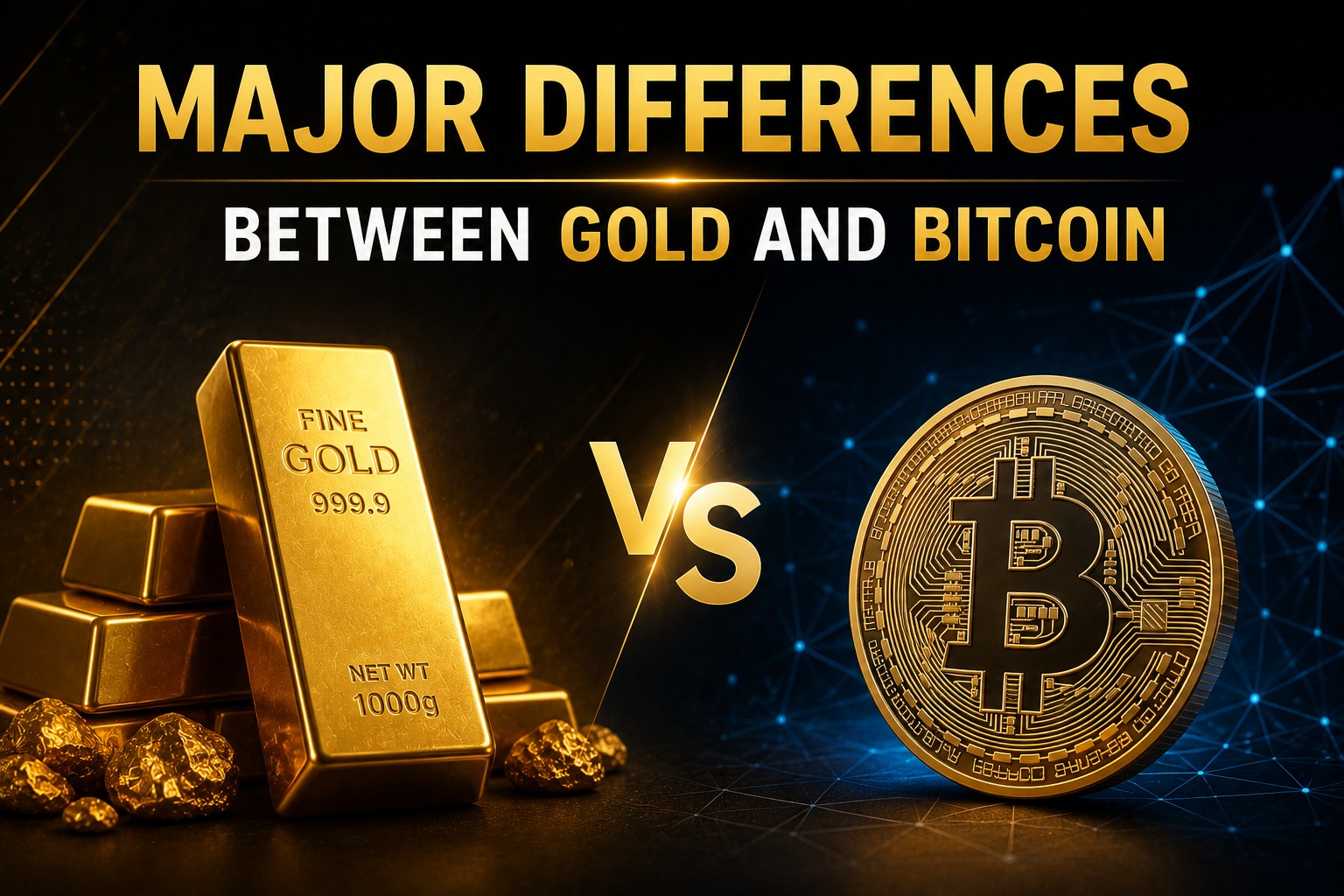
Major Differences Between Gold and Bitcoin
1. Physical vs Digital
Gold is a physical asset—you can hold it, store it, and use it in industries. Bitcoin is completely digital and exists only on the blockchain.
This creates a fundamental difference in how they are stored and used.
2. Volatility and Risk
Bitcoin has historically experienced substantially higher price volatility than gold. This means its price can move sharply over relatively short periods, creating both greater potential upside and greater downside risk.
Gold can also experience price fluctuations, but its longer market history and generally lower volatility make its risk profile different from Bitcoin's.
3. Growth Potential
Bitcoin has experienced substantial price appreciation during some periods of its relatively short history, although these gains have also been accompanied by significant volatility and drawdowns. Gold has generally followed a more moderate price path and is often valued for its long-established role rather than short-term growth potential.
4. Portability
Transporting gold can be expensive and difficult, especially in large quantities. Bitcoin can be transferred across borders instantly with minimal cost.
5. Track Record
Gold has a history of over 5,000 years as a store of value. Bitcoin is relatively new, with just over a decade of history.
This gives gold a substantially longer track record than Bitcoin and helps explain its established role in traditional markets.
Read more: Where to Buy Bitcoin Online: Best Platforms Compared
Bitcoin Investment vs Gold Investment: A Practical Comparison
Bitcoin and gold share similarities as scarce assets, but they differ significantly as investments. Bitcoin offers digital scarcity, easy transferability, and higher historical volatility, while gold has a much longer track record and is generally less volatile. Here’s how they compare across the key factors:
| Factor | Bitcoin | Gold |
|---|---|---|
| Supply | Maximum 21 million BTC | Finite geological supply |
| Historical volatility | Very high | Generally lower |
| Physical ownership | No | Yes |
| Digital transferability | Very high | Low |
| Historical track record | Since 2009 | Thousands of years |
| Historical price performance | Higher historical upside with higher volatility | Generally lower volatility |
| Custody | Digital wallet or exchange | Vault, bank, dealer, etc. |
Which Is Better for Wealth Preservation?
When it comes to wealth preservation, gold has a much longer track record as a store-of-value asset. Its scarcity, durability, and established role in global markets have made it a popular choice for investors seeking long-term wealth preservation. However, gold can still experience price fluctuations and is not immune to market risk.
Bitcoin offers a different approach. Its fixed maximum supply of 21 million BTC and decentralized network attract investors who value digital scarcity and independence from traditional financial systems. Some investors also view its limited supply as a potential hedge against currency debasement. However, Bitcoin's relatively short history and higher volatility make it a less established wealth-preservation asset than gold.
For investors prioritizing a long historical track record, gold may be more suitable. Those comfortable with greater risk may consider Bitcoin for its digital scarcity, portability, and potential growth. Neither asset should be considered a guaranteed hedge or risk-free investment.
Is Bitcoin Better Than Gold?
There’s no one-size-fits-all answer to “Is Bitcoin better than gold?” The better choice depends on what you want an asset to contribute to your portfolio and how much risk you're willing to accept.
Choose Bitcoin if you want:
- Higher growth potential with higher risk
- Exposure to digital assets
- Easy global transferability
- Participation in the growing crypto economy
Choose Gold if you want:
- A long-established asset used for wealth preservation
- Generally lower volatility than Bitcoin
- Exposure to an asset that has historically played a role during periods of financial uncertainty
For some investors, Bitcoin and gold can complement each other by providing exposure to assets with different characteristics rather than requiring a choice between the two.
Bitcoin vs Gold: Why You Don’t Have to Choose One
Bitcoin and gold don't necessarily have to be competing investments. Because they have different characteristics, some investors choose to hold both as part of a diversified portfolio.
Gold provides exposure to a long-established physical asset, while Bitcoin provides exposure to a newer digital asset. Holding both can give investors different sources of potential value, although diversification does not eliminate investment risk.
Bitcoin vs Gold: Which May Be Right for Your Investment Goals?

Choosing between Bitcoin and gold ultimately comes down to your investment objectives, risk tolerance, time horizon, and preferred form of ownership.
Investors who value physical assets and a long-established market may prefer gold, while those interested in digital assets and comfortable with greater volatility may prefer Bitcoin.
There is also no requirement to choose only one. Some investors may consider both as part of a broader diversified strategy.
Read more: The Complete Guide to Buying Jewelry With Bitcoin
How Bitcoin Is Becoming Part of Modern Lifestyle
Bitcoin is evolving beyond an investment asset and becoming part of a broader digital lifestyle. People are using Bitcoin to invest, make payments, and purchase real-world products, bringing cryptocurrency into more everyday experiences.
Beyond investing, Bitcoin has also become part of a broader digital culture, influencing payments, technology, design, and lifestyle.
For those who want to express their connection to Bitcoin beyond the digital world, the Bitcoin Butik collection offers premium Bitcoin jewelry designed for enthusiasts who want to carry that connection into their everyday style.
Conclusion
Bitcoin and gold serve different roles. Gold offers a much longer history as a store of value, while Bitcoin represents a newer form of digital scarcity with greater volatility and potential upside. The better choice depends on your goals, risk tolerance, and investment horizon. For some investors, both may have a place within a diversified strategy.
As Bitcoin continues to expand beyond investing into technology, payments, and lifestyle, its influence is becoming increasingly visible in the real world. Explore Bitcoin Butik's premium Bitcoin jewelry collection to discover pieces designed for those who want to express their connection to the Bitcoin community beyond the digital world.
Disclaimer: This article is for informational and educational purposes only and should not be considered financial or investment advice. Bitcoin and gold both carry risks, and past performance does not guarantee future results.
Frequently Asked Questions
1. Is Bitcoin better than gold as an investment?
There is no universal winner. Gold generally offers lower volatility and a much longer track record, while Bitcoin offers higher growth potential but significantly greater risk. The better option depends on your investment goals, risk tolerance, and time horizon.
2. Which is safer, Bitcoin or gold?
Gold is generally considered the more stable option because of its long history and lower price volatility. Bitcoin can experience significant price fluctuations, making it better suited to investors who are comfortable with higher risk.
3. Is Bitcoin a better store of value than gold?
Gold has a proven history as a store of value spanning thousands of years. Bitcoin is a newer asset with a fixed maximum supply and growing adoption, but its shorter history and higher volatility make the comparison less straightforward.
4. Can Bitcoin replace gold as a wealth-preservation asset?
Bitcoin has some characteristics that resemble gold, such as scarcity and independence from traditional monetary systems. However, Bitcoin's relatively short track record and high volatility mean it has not yet established the same historical role in wealth preservation as gold.
5. Which has more growth potential, Bitcoin or gold?
Bitcoin has experienced substantially higher price appreciation during some periods of its history, but that has come with substantially higher volatility and risk. Past performance does not guarantee future returns, so neither asset's future growth can be predicted with certainty.
6. Is Bitcoin more volatile than gold?
Yes. Bitcoin has historically experienced much larger price swings than gold. This higher volatility can create opportunities for growth but also increases the potential for significant losses.
7. Should I invest in Bitcoin or gold?
The choice depends on your objectives. Gold may appeal to investors seeking stability and long-term wealth preservation, while Bitcoin may suit those seeking exposure to digital assets and willing to accept greater risk.
8. Can you invest in both Bitcoin and gold?
Yes. Some investors hold both as part of a diversified portfolio. Because Bitcoin and gold have different characteristics, owning both can provide exposure to digital scarcity as well as a long-established physical asset.
9. Is Bitcoin a good hedge against inflation?
Bitcoin's fixed maximum supply is one reason some investors view it as a potential hedge against currency debasement. However, its high volatility means it does not consistently behave like a traditional inflation hedge, and its effectiveness can vary depending on market conditions.
10. Why is Bitcoin called digital gold?
Bitcoin is often called “digital gold” because both assets are scarce and are frequently discussed as alternatives to traditional currencies and stores of value. However, Bitcoin is digital and highly portable, while gold is a physical asset with thousands of years of history.