Quick Login (Optional)
Login is completely optional. Your cart will be saved automatically for this browser session.
Continue as Guest
No account needed! Your cart is automatically saved for this browser session.
Create new account
Create your account to be part of the BitcoinButik world, discover our new collections and receive news from the Maison.
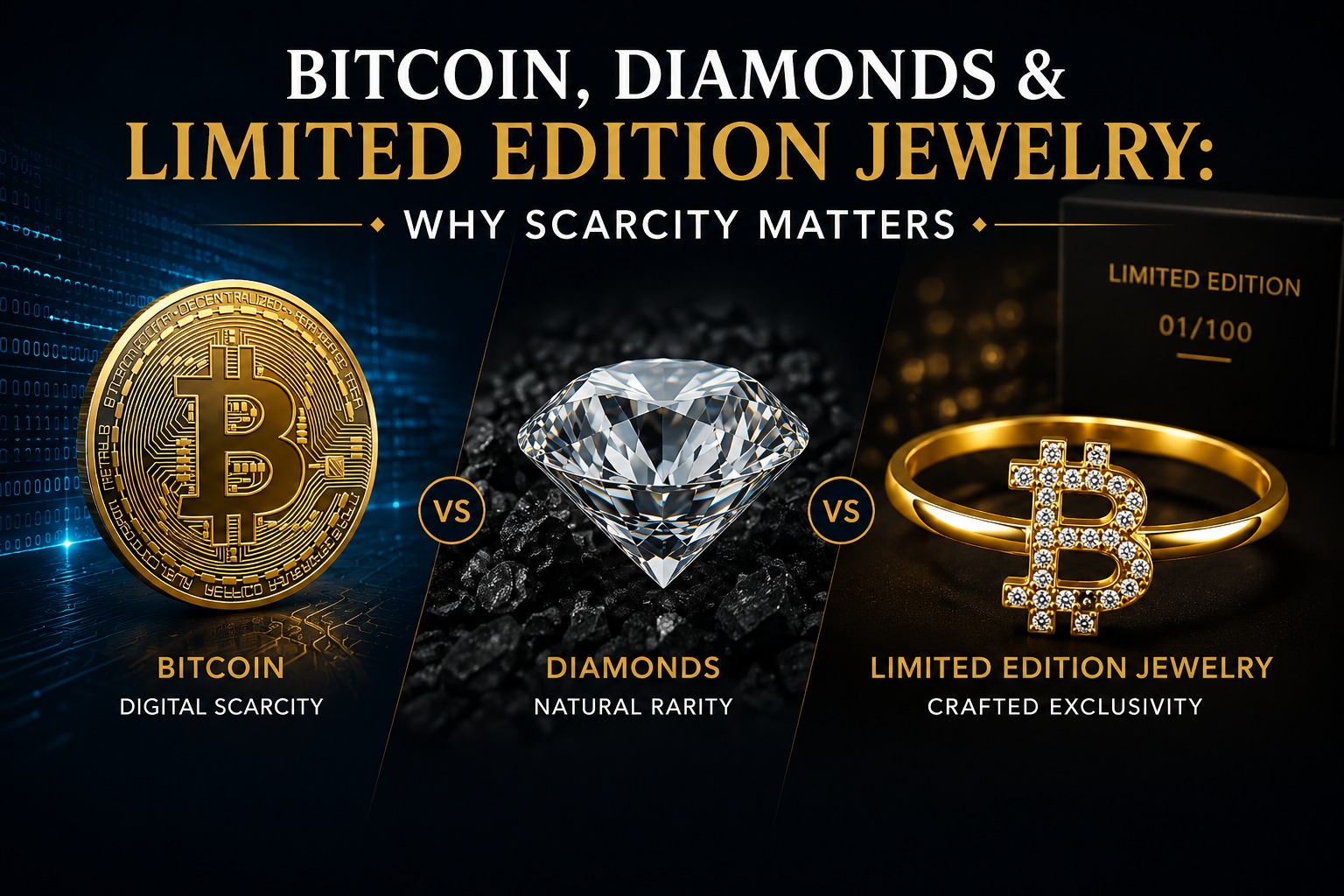
Bitcoin, Diamonds & Limited Edition Jewelry: Why Scarcity Matters
Why do people place a premium on things they cannot easily obtain? From Bitcoin's fixed supply to the geological rarity of natural diamonds and the restricted production of limited-edition jewelry, scarcity has always played an important role in shaping demand, exclusivity, and perceived value.
Bitcoin demonstrates digital scarcity through its maximum supply of 21 million coins, while diamonds derive rarity from geological conditions, quality, and limited natural availability. Limited edition jewelry takes a different approach, combining restricted production with craftsmanship, design, materials, provenance, and exclusivity.
Although these assets are fundamentally different, they share an important principle: rarity becomes more meaningful when it is supported by genuine demand, quality, and a reason to own it. Understanding this distinction helps explain why certain rare assets attract collectors, command premium prices, and remain desirable over time.
What Is Scarcity and Why Does It Matter?
Scarcity refers to the limited availability of a resource relative to demand. When something is rare and cannot be easily reproduced, its perceived value increases—especially when there is strong interest or emotional attachment from buyers.
In simple terms:
- The less there is of something, the more valuable it tends to become
- Scarcity creates exclusivity
- Exclusivity fuels demand
- Demand combined with limited supply can support stronger perceived value and, in some markets, premium pricing.
Scarcity is not just about rarity—it’s about perceived importance. A rare item with no demand has little value, but when rarity meets desirability, the result is powerful.
This principle applies equally to financial assets like Bitcoin and tangible goods like diamonds and jewelry.
Read more: What Is Bitcoin?
How Bitcoin Creates Digital Scarcity
Bitcoin is often referred to as “digital gold” because of its limited supply and scarcity-driven monetary design. Unlike traditional currencies, Bitcoin follows a predetermined issuance system built into its protocol. Its supply cannot simply be increased by a central authority, making its scarcity transparent, measurable, and fundamentally different from many traditional assets.
Bitcoin's scarcity is based on several key characteristics:
1. Fixed Supply
Changing Bitcoin's maximum supply would require participants across the network to adopt and enforce a different set of consensus rules. The fixed supply is one of Bitcoin's defining characteristics and an important part of its economic model.
2. Predictable Issuance
New bitcoins enter circulation through the mining process according to a predetermined schedule. This means market participants can understand how new supply is introduced over time rather than relying on decisions made by a central bank or financial institution.
3. Halving Events
Approximately every four years, Bitcoin undergoes a halving event, reducing the number of new bitcoins created as mining rewards. This gradually decreases the rate of new supply entering circulation and reinforces Bitcoin's scarcity over the long term.
4. Decentralized Monetary Rules
Bitcoin does not have a central bank or single institution responsible for controlling its supply. Instead, its monetary rules are maintained through its protocol and decentralized network of participants. This makes Bitcoin's supply model different from traditional currencies, where monetary policy can influence the amount of money in circulation.
What Makes Bitcoin’s Scarcity Different?
Bitcoin's scarcity has several important characteristics:
- Transparent: Its supply and issuance rules can be publicly verified.
- Predictable: New supply follows a predetermined schedule.
- Limited: The maximum supply is set at 21 million bitcoins.
- Global: Bitcoin can be transferred and accessed across borders.
- Digitally scarce: Its supply is controlled by network rules rather than simple digital duplication.
These characteristics have led some investors to view Bitcoin as a potential store of value and an alternative asset within a diversified portfolio. However, scarcity alone does not guarantee price appreciation. Bitcoin's value is also influenced by demand, adoption, market conditions, regulation, liquidity, and investor sentiment.
Why Diamonds Are Associated With Rarity and Luxury
Diamonds have long represented luxury, rarity, status, and exclusivity. Unlike Bitcoin, where scarcity is built into a digital protocol, diamond scarcity comes primarily from nature. Natural diamonds form deep within the Earth under extraordinary pressure and temperatures over extremely long geological periods, making their formation and extraction a rare process.
However, rarity alone does not determine a diamond's value. Factors such as quality, size, color, clarity, cut, provenance, consumer demand, and market conditions all influence how a diamond is valued.
Why Are Diamonds Valuable?
1. Geological Rarity
Natural diamonds form deep within the Earth's mantle under extreme heat and pressure over millions or even billions of years. The specific geological conditions required for their formation make naturally occurring diamonds a relatively rare natural resource.
2. Limited Natural Availability
Unlike manufactured goods, natural diamonds cannot simply be produced whenever demand increases. They must be discovered and extracted through mining, while the availability of economically viable deposits influences how much natural diamond supply reaches the market.
3. Quality Determines Desirability
Not every diamond is equally rare or valuable. The 4Cs—cut, color, clarity, and carat weight—play a major role in determining its quality and desirability. A larger diamond, an exceptionally clear stone, or one with a particularly desirable color can command significantly more attention than a more common stone.
4. Cultural and Emotional Significance
Diamonds have become deeply connected with engagements, anniversaries, celebrations, luxury fashion, and important personal milestones. This cultural significance has helped sustain demand and transformed diamonds from geological materials into symbols of commitment, achievement, and enduring luxury.
5. Durability and Longevity
Diamond ranks 10 on the Mohs hardness scale and is the hardest naturally occurring mineral, making it exceptionally resistant to scratching. This durability makes diamond jewelry suitable for everyday wear and allows well-maintained pieces to be passed between generations, adding an important heirloom dimension to their appeal.
Understanding How Diamond Scarcity Works
Diamond scarcity is fundamentally different from Bitcoin's programmed scarcity. Bitcoin has a predetermined maximum supply, while diamond availability depends on geology, mining, discoveries, technology, production economics, and market demand.
Unlike Bitcoin:
- Diamond supply is not fixed at a predetermined limit
- New discoveries can increase the available supply
- Different diamonds have very different levels of rarity
- Quality and grading strongly influence desirability and price
- Market demand and consumer perception influence value
There is also an important distinction between natural and lab-grown diamonds. Natural diamonds are formed through geological processes, while lab-grown diamonds are produced using controlled technological methods. Although they share the same basic chemical composition and crystal structure, their different origins create different perceptions of rarity and scarcity.
Read more: How to Buy Bitcoin Safely in 2026
When Scarcity Meets Craftsmanship in Limited Edition Jewelry
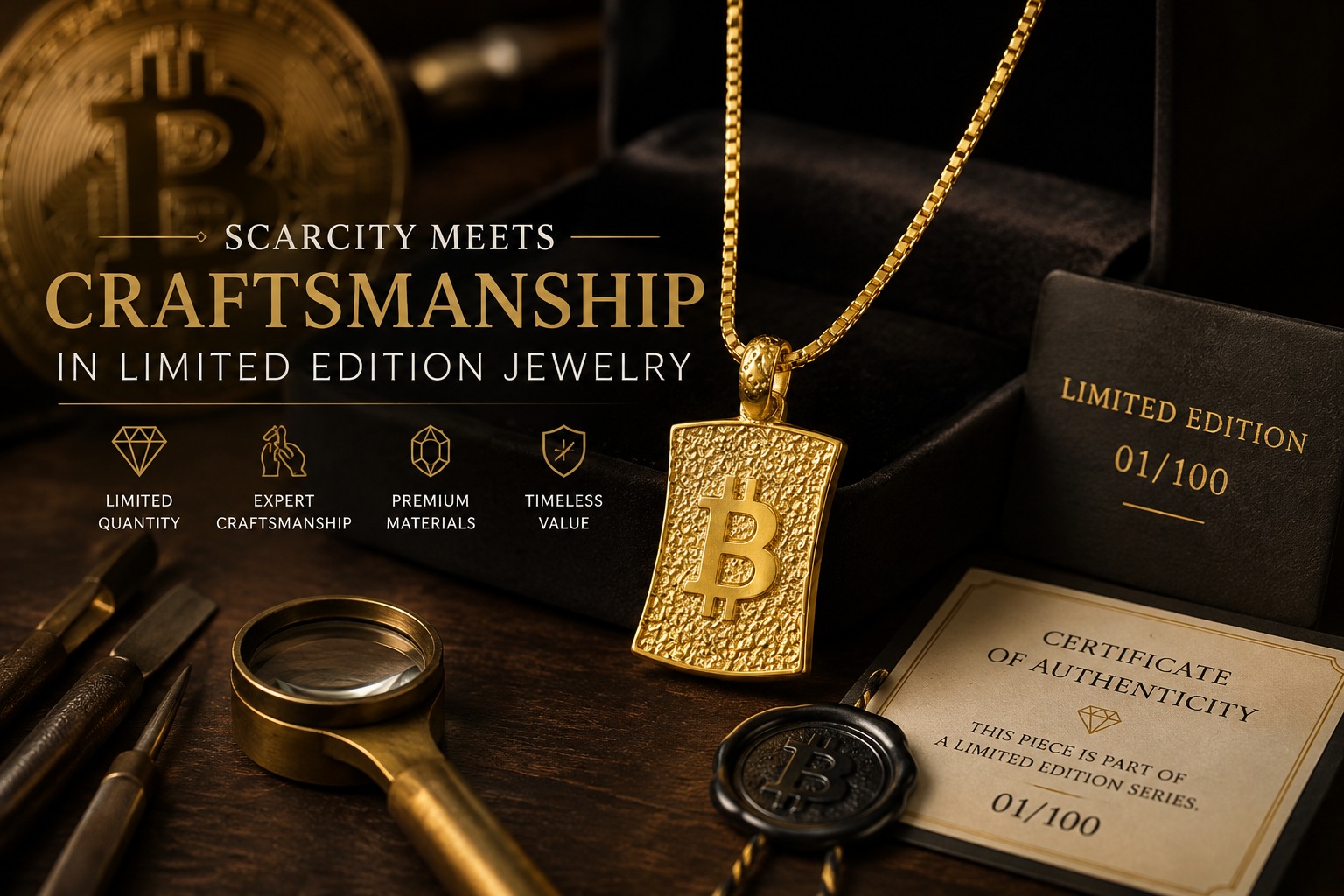
Limited edition jewelry brings together three powerful elements: rarity, craftsmanship, and exclusivity. Unlike mass-produced jewelry, these pieces are created in restricted quantities, giving collectors and buyers an opportunity to own something that is not widely available. The combination of limited production and distinctive design can make each piece feel more personal, collectible, and meaningful.
But limited edition jewelry is not valuable simply because fewer pieces exist. Its appeal often comes from the combination of scarcity, materials, craftsmanship, design, brand reputation, provenance, and consumer demand.
What Defines Limited Edition Jewelry?
1. Limited Production
One of the defining characteristics of limited-edition jewelry is its restricted production. A designer or brand may create only a specific number of pieces, such as 25, 50, or 100. Once the edition is complete, the design may no longer be produced, creating a clear sense of exclusivity.
2. Distinctive Design and Craftsmanship
Limited edition pieces often provide designers with greater freedom to experiment with unique designs, unusual details, precious materials, or specialized techniques. This transforms jewelry from a simple accessory into a form of wearable art and craftsmanship.
3. Materials and Quality
The materials used can significantly influence the appeal of a limited edition piece. Precious metals, diamonds, gemstones, and high-quality finishing can add both aesthetic and material value. However, material quality should be considered alongside rarity and craftsmanship rather than treated as the only measure of worth.
4. Brand and Designer Reputation
The reputation of the designer or jewelry brand can contribute significantly to desirability. A limited collection from an established or highly regarded creator may attract collectors because of its design heritage, craftsmanship, reputation, and story.
5. Edition Numbers and Provenance
Numbered pieces, certificates of authenticity, original packaging, and documented provenance can make scarcity easier to establish. For collectors, knowing that a piece belongs to a specific and finite edition can add another layer of appeal.
6. Emotional and Personal Value
Jewelry often carries meaning beyond its material components. A limited edition piece may represent a milestone, relationship, achievement, personal belief, or connection to a particular community or idea. This emotional significance can make ownership more valuable to the individual collector.
When Does Limited Edition Jewelry Become Collectible?
Limited production does not automatically guarantee that jewelry will increase in value. However, a piece can develop collectible appeal when scarcity is combined with strong craftsmanship, desirable materials, distinctive design, provenance, brand recognition, and sustained demand.
Collectors may be particularly interested in pieces that have:
- A genuinely limited production quantity
- Distinctive or original design
- High-quality materials and craftsmanship
- Strong brand or designer recognition
- Verifiable authenticity and provenance
- A meaningful cultural or artistic story
- Continued demand among collectors
Limited-edition jewelry can occupy an interesting position between luxury goods, personal possessions, and collectibles. Some pieces may retain or increase their value over time, while others may depreciate depending on market demand, condition, brand reputation, materials, and resale conditions.
For this reason, limited-edition jewelry should not be viewed as a guaranteed investment. Its strongest appeal often comes from the combination of ownership, craftsmanship, exclusivity, and potential collectibility.
Comparing Bitcoin, Diamonds, and Limited-Edition Jewelry
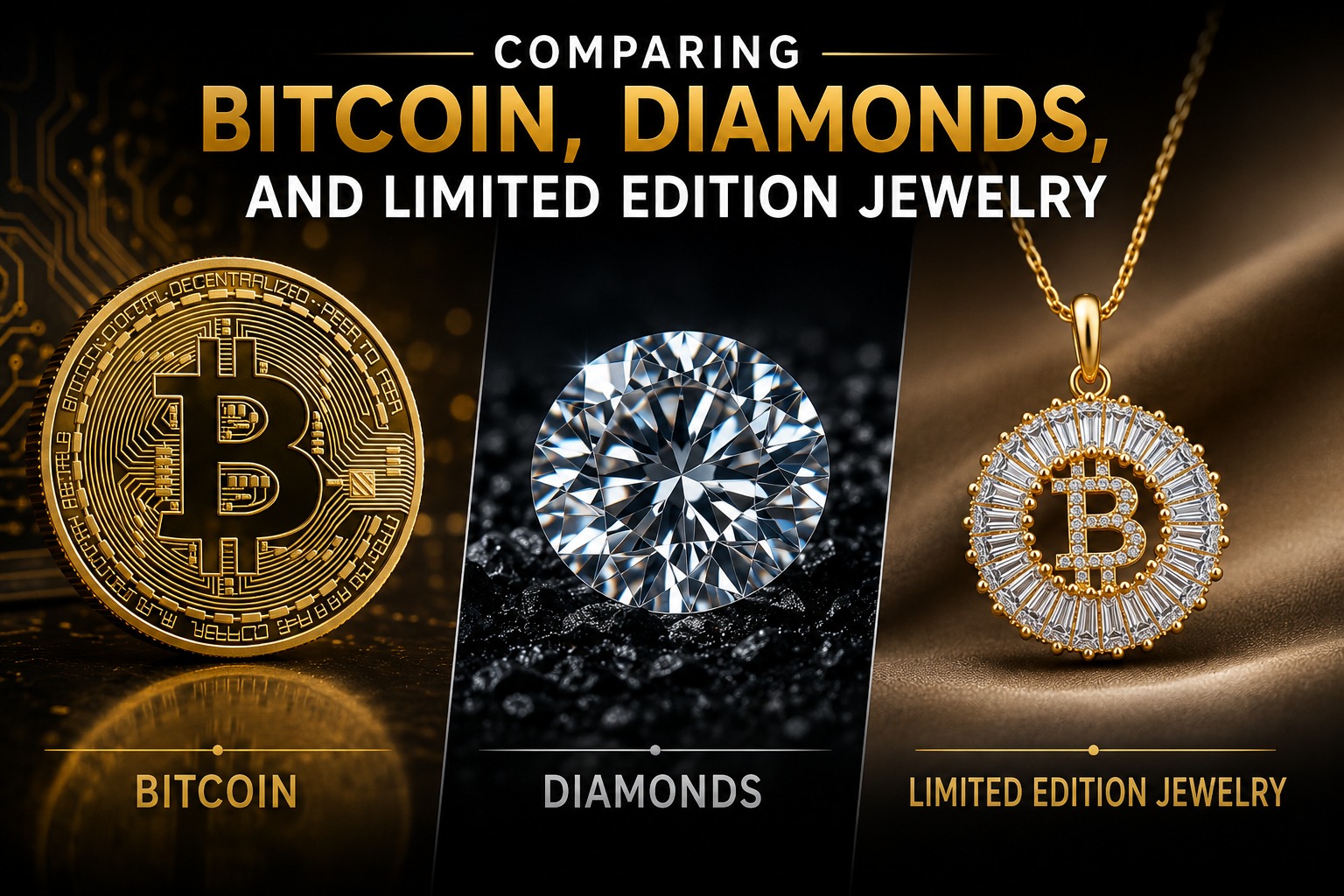
Bitcoin, diamonds, and limited-edition jewelry belong to very different worlds, yet they share a common principle: limited availability can make something more desirable. What sets them apart is the way scarcity is created and how buyers perceive and measure that rarity.
Bitcoin uses a predetermined digital supply model; diamonds derive their rarity from geological formation and limited natural resources, while limited edition jewelry combines restricted production with craftsmanship, design, materials, and exclusivity.
How Scarcity Works Across Bitcoin, Diamonds, and Jewelry
- Bitcoin: Scarcity created through a transparent, protocol-based supply limit.
- Diamonds: Scarcity shaped by nature, geological availability, mining, quality, and market demand.
- Limited Edition Jewelry: Scarcity intentionally created through restricted production and enhanced by design and craftsmanship.
Bitcoin vs. Diamonds vs. Limited Edition Jewelry
| Feature | Bitcoin | Diamonds | Limited Edition Jewelry |
|---|---|---|---|
| Supply Model | Maximum of 21 million | Naturally limited, but not fixed | Deliberately restricted |
| Scarcity Type | Digital and algorithmic | Natural and geological | Manufactured and intentional |
| Physical Form | Digital | Physical | Physical |
| How Rarity Is Measured | Protocol and circulating supply | Geological availability and diamond characteristics | Edition size, materials, craftsmanship and provenance |
| Key Value Drivers | Scarcity, demand, adoption and utility | Rarity, 4Cs, provenance and demand | Design, craftsmanship, materials, brand and exclusivity |
| Emotional Appeal | Symbolic and cultural | Strong luxury and sentimental appeal | Strong personal and collectible appeal |
| Collectibility | Digital asset | Gemstone and luxury collectible | Luxury collectible |
| Supply Control | Governed by network consensus | Influenced by geology and mining | Controlled by the designer or brand |
| Transparency | Highly verifiable | Varies by grading and provenance | Depends on documentation and brand practices |
Which Is Scarcer: Bitcoin, Diamonds, or Jewelry?
There is no simple answer because scarcity works differently for each one.
Bitcoin has a clearly defined maximum supply, making its monetary scarcity highly predictable and publicly verifiable. Diamonds do not have a fixed global supply cap, but exceptional natural diamonds can be extremely rare because of their specific size, color, clarity, and provenance. Limited edition jewelry can be scarce by design, particularly when a collection has a small production run and will not be reproduced.
What Makes Limited Edition Jewelry Different?
The most interesting distinction is that limited-edition jewelry combines scarcity with craftsmanship. A piece is not valued only because fewer units exist. Its appeal can also come from the materials used, the skill involved in creating it, the story behind the design, the reputation of the maker, and the emotional connection it creates with its owner.
This gives limited-edition jewelry a unique position between luxury, art, and collectibility.
What These Three Assets Tell Us About Scarcity
- Bitcoin represents programmed digital scarcity with a predetermined maximum supply.
- Diamonds represent natural scarcity, where geology, quality, provenance, and demand influence rarity and value.
- Limited edition jewelry represents intentional scarcity, combining restricted production with craftsmanship, design, and exclusivity.
- Scarcity alone does not guarantee value—demand, quality, trust, utility, provenance, and cultural significance also matter.
Ultimately, these three categories show that scarcity can take many forms. Bitcoin makes scarcity digital, diamonds make it natural, and limited-edition jewelry turns it into a tangible expression of craftsmanship and exclusivity.
Read more: Where to Buy Bitcoin with Lowest Fees
How Scarcity Can Influence Value
Scarcity can play an important role in determining how people perceive and value an asset, but rarity alone does not guarantee financial value or future appreciation. For scarcity to translate into meaningful market value, it usually needs to be supported by strong demand, quality, credibility, utility, and a reason for people to continue wanting the asset.
This is why the same principle can produce very different outcomes across Bitcoin, diamonds, and limited-edition jewelry.
What Turns Scarcity Into Value?
1. Demand
Scarcity becomes meaningful when people actually want the limited asset. Even an extremely rare item may have little market value if there is no sustained demand for it. Strong demand combined with restricted supply can create competition among buyers and support premium pricing.
2. Utility and Purpose
An asset's usefulness can strengthen its perceived value. Bitcoin provides digital and financial utility, while jewelry can offer aesthetic, cultural, symbolic, and collectible value. When scarcity is combined with a clear purpose or use case, it can become more meaningful to buyers.
3. Trust and Credibility
Buyers need confidence that an asset is genuinely scarce and that its scarcity will remain meaningful. For Bitcoin, supply rules can be publicly verified through its protocol. For diamonds and jewelry, grading, authentication, provenance, certificates, and reputable sellers can help establish credibility.
4. Barriers to Replication
The harder something is to reproduce, obtain, or replace, the stronger its potential scarcity can be. Bitcoin's protocol limits its supply; natural diamonds require specific geological conditions; and limited edition jewelry may involve specialized craftsmanship, materials, and restricted production.
5. Quality and Craftsmanship
Scarcity becomes more powerful when it is paired with quality. In limited-edition jewelry, for example, a small production run can become more desirable when combined with exceptional craftsmanship, precious materials, distinctive design, and attention to detail.
6. Cultural Relevance
Assets can gain lasting appeal when they carry cultural, historical, or symbolic meaning. Diamonds are associated with milestones and luxury; Bitcoin represents a new approach to digital money and ownership, while collectible jewelry can represent artistic movements, communities, designers, or personal identity.
Scarcity Is Only One Part of the Equation
An asset's long-term appeal depends on what makes people want to own it and whether that demand continues over time.
A useful way to think about it is:
Scarcity + Demand + Quality + Trust + Utility + Meaning = Potential Long-Term Value
This is why Bitcoin, diamonds, and limited-edition jewelry can all benefit from scarcity while behaving very differently in the market. Their value depends not only on how rare they are but also on why people consider them worth owning.
The Psychology Behind Scarcity
Scarcity influences more than prices and markets—it also shapes how people perceive desirability, exclusivity, and ownership. When something is difficult to obtain or available only in limited quantities, it can feel more distinctive and valuable.
People often tend to:
- Desire what is difficult to obtain: Limited availability can make an item feel more desirable.
- Associate rarity with exclusivity: Rare or hard-to-access products can signal uniqueness, status, or individuality.
- Place greater importance on limited opportunities: Knowing that an item may not be available later can increase the urgency to purchase.
- Value uniqueness: Collectors often seek pieces that feel different from mass-produced alternatives.
This psychological effect helps explain why limited releases, exclusive collections, rare gemstones, and collectible assets can attract attention and command premium prices. However, scarcity works best when it is supported by genuine quality, demand, craftsmanship, or meaningful utility.
When Bitcoin Meets the World of Luxury
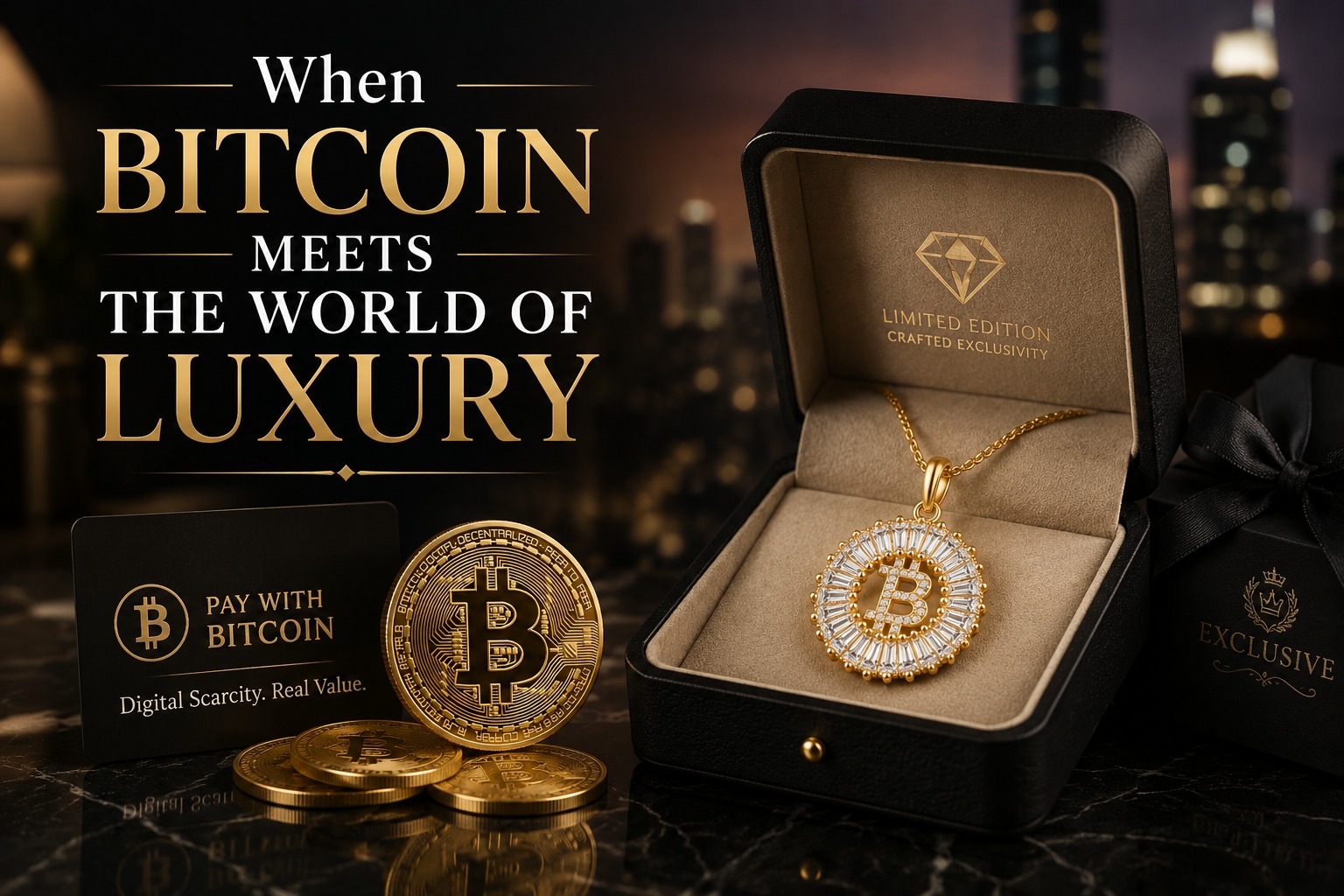
The relationship between digital assets and physical luxury is creating a new way to think about ownership. Bitcoin represents digital scarcity, while limited-edition jewelry represents physical scarcity through restricted production, craftsmanship, and exclusivity. Bringing the two together allows Bitcoin holders to use a digitally scarce asset to acquire a tangible luxury item.
For collectors and Bitcoin enthusiasts, this creates an interesting intersection:
- Digital scarcity: Bitcoin's predetermined supply model
- Physical scarcity: Limited production of exclusive jewelry
- Craftsmanship: Artistic design and skilled production
- Collectibility: Ownership of pieces that may not be widely available
- Luxury: Tangible assets that can be worn, displayed, and enjoyed
Why the Connection Between Bitcoin and Luxury Matters
Using Bitcoin to purchase luxury jewelry is more than a payment option—it represents a connection between digital wealth and physical ownership. A Bitcoin holder can use cryptocurrency to acquire a tangible piece of craftsmanship while remaining connected to the culture and principles surrounding digital scarcity.
For collectors, this can provide an alternative way to express their interest in Bitcoin through something physical and personal. For luxury brands and jewelry platforms, accepting Bitcoin can also open access to a global audience of cryptocurrency users.
The combination of Bitcoin and luxury jewelry demonstrates how digital scarcity and physical scarcity can intersect. Bitcoin brings the concept of programmable scarcity, while limited-edition jewelry transforms scarcity into something tangible, wearable, and collectible.
Read more: Why Bitcoin Jewelry Is More Than Just an Accessory
Scarcity and the Role of Rare Assets in Wealth Preservation
Scarce assets can play an interesting role in wealth preservation because their limited availability may support long-term demand. Bitcoin, diamonds, and luxury collectibles, such as limited-edition jewelry, each approach scarcity differently, but all demonstrate how limited supply can influence how people perceive and hold value over time.
However, scarcity should not be viewed as a guarantee of wealth preservation or future returns. The performance of any asset depends on factors such as demand, market conditions, liquidity, quality, regulation, and broader economic trends.
Why Collectors and Investors Consider Scarce Assets
1. Limited Supply
Assets with restricted or naturally limited supply may have a different value dynamic from assets that can be produced without meaningful constraints. Bitcoin's protocol-defined supply, natural diamonds' geological limitations, and limited-edition jewelry's restricted production all demonstrate different forms of scarcity.
2. Potential Long-Term Value
When scarcity is combined with sustained demand, quality, and strong market recognition, an asset may retain or potentially increase its value over time. However, appreciation is never guaranteed, particularly in markets for collectibles and luxury goods.
3. Portfolio Diversification
Some investors and collectors consider alternative assets as part of a broader strategy to diversify beyond traditional financial holdings. Bitcoin and luxury collectibles can behave differently from conventional assets, although they also carry their own risks.
4. Tangible Ownership
Luxury collectibles such as limited-edition jewelry offer something that digital assets cannot: physical ownership and personal use. A collector can wear, display, preserve, or pass a piece on to another generation while also appreciating its design and craftsmanship.
5. Independence and Alternative Ownership
Bitcoin offers a decentralized form of digital ownership, while physical collectibles provide direct ownership of tangible goods. These different forms of ownership can appeal to people looking beyond conventional financial assets.
For Bitcoin enthusiasts interested in expressing their connection to digital scarcity through physical luxury, exploring a curated collection of Bitcoin jewelry offers a tangible way to bring these ideas together.
Conclusion
Scarcity is a powerful concept that connects Bitcoin, diamonds, and limited-edition Bitcoin jewelry, even though each achieves rarity in a different way. Bitcoin represents digital scarcity through its predetermined supply; diamonds reflect natural scarcity shaped by geology and quality, while limited edition jewelry combines restricted production with craftsmanship, design, and exclusivity.
However, scarcity alone does not guarantee value. Demand, quality, authenticity, craftsmanship, utility, provenance, and cultural significance all influence whether a rare asset remains desirable over time. For collectors and luxury buyers, this distinction is important because something becomes truly compelling when rarity is supported by meaningful value.
As the worlds of cryptocurrency and luxury continue to intersect, limited-edition jewelry offers an interesting way to turn the idea of digital scarcity into something physical, wearable, and collectible. For Bitcoin enthusiasts and collectors, exploring scarce luxury pieces can provide a tangible connection between Bitcoin's culture of limited supply and the timeless appeal of exceptional craftsmanship.
Frequently Asked Questions
1. What is scarcity and why does it matter?
Scarcity means that something has limited availability relative to demand. When rarity is combined with strong demand, quality, or cultural significance, it can increase an asset's desirability and perceived value.
2. Why is Bitcoin considered a scarce asset?
Bitcoin is considered scarce because its protocol establishes a maximum supply of 21 million bitcoins. New bitcoins are introduced according to a predetermined issuance schedule, making their supply more predictable than many traditional currencies.
3. How is Bitcoin scarcity different from diamond scarcity?
Bitcoin's scarcity is digital and protocol-based, while diamond scarcity is primarily natural and geological. Bitcoin has a predetermined maximum supply, whereas diamond availability depends on geological deposits, mining, discoveries, quality, and market conditions.
4. Are diamonds actually scarce?
Natural diamonds are a relatively scarce natural resource, but their supply is not fixed at a specific global limit. Their rarity and value vary considerably based on factors such as carat weight, color, clarity, cut, provenance, and market demand.
5. What makes limited-edition jewelry valuable?
Limited edition jewelry can be desirable because of its restricted production, craftsmanship, materials, design, brand reputation, provenance, and exclusivity. Strong collector demand can further increase its appeal.
6. Is limited-edition jewelry a good investment?
Limited-edition jewelry can have collectible or resale value, but it should not be considered a guaranteed investment. Its future value depends on factors such as craftsmanship, materials, condition, brand reputation, provenance, scarcity, and continued market demand.
7. What is the difference between limited-edition jewelry and regular jewelry?
Limited edition jewelry is produced in a restricted quantity, often with a specific edition size or numbered pieces. Regular jewelry may be produced continuously or in larger quantities, making limited edition pieces potentially more exclusive and collectible.
8. Can limited-edition jewelry become a luxury collectible?
Yes. A limited edition piece can develop collectible appeal when it combines genuine scarcity, distinctive design, exceptional craftsmanship, quality materials, provenance, and sustained demand. However, limited production alone does not guarantee collectibility.
9. Does scarcity automatically increase an asset's value?
No. Scarcity alone does not guarantee value. An asset generally needs meaningful demand, quality, utility, trust, authenticity, or cultural significance for its limited supply to translate into stronger perceived value.
10. How does Bitcoin connect with limited-edition jewelry?
Bitcoin represents digital scarcity, while limited-edition jewelry represents physical scarcity through restricted production and craftsmanship. Using Bitcoin to purchase luxury jewelry creates a connection between digital ownership and tangible, collectible goods.